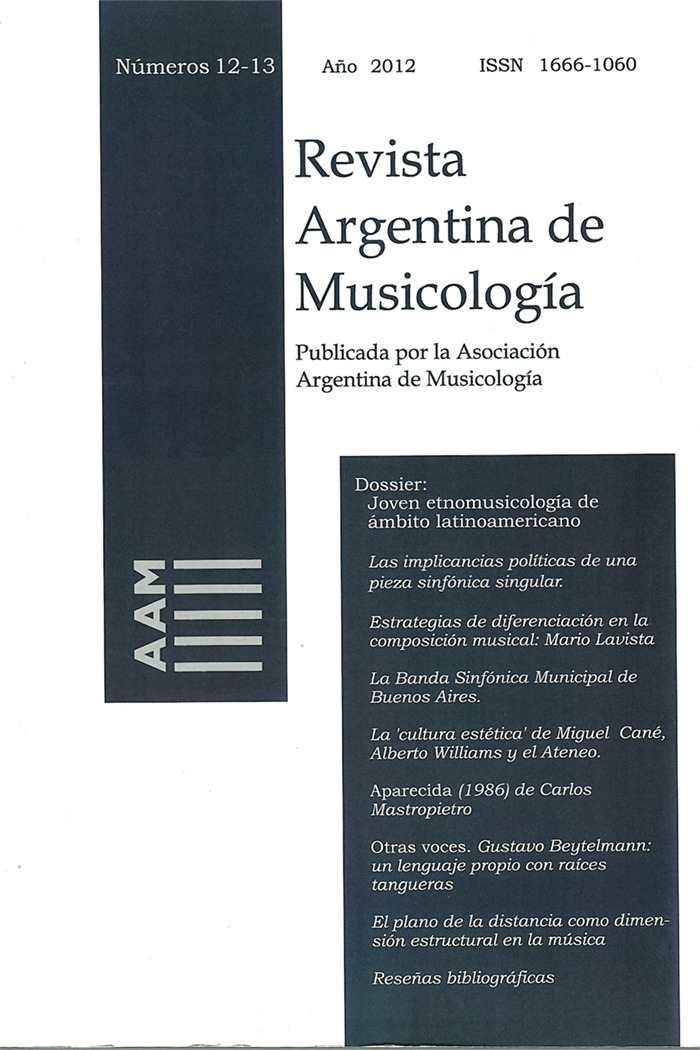
The ‘aesthetic culture’ of Miguel Cané, Alberto Williamsand the Ateneo. Aestheticist discourse and argumentation about the Wagner Festival (1894).
Keywords:
Cultural history, discourse analysis, symphonic music, aestheticism, spiritualismAbstract
Faced with the adverse effects of modernity at the end of the 19th century, the intellectual élite of Buenos Aires argued against ‘moral materialism’ with arguments responding to an ‘aesthetic culture’. In this context, some writers and artists created the Ateneo and organized a series of orchestral concerts directed by Alberto Williams, the first of which was the Wagner Festival.
This article analyzes a letter from Miguel Cané about that festival, published in the journal La Nación in 1894. This paper aims to explain how it manifests, justifies, and embodies a cultural position in which were aligned Cané as an intellectual, the Ateneo as an institution, Alberto Williams as an artist and the Festival as aesthetic statement. The letter can be read as an ideological stance: ‘aesthetic spiritualism’ and an aesthetic program against ‘moral materialism’. Discourse analysis is based on three aspects: the subject of énonciation, the regularities of speech and the argumentation.
Downloads
Downloads
Published
Issue
Section
License
Copyright (c) 2018 Asociación Argentina de Musicología

This work is licensed under a Creative Commons Attribution-NonCommercial 4.0 International License.
Attribution-NonCommercial 4.0 International
Licencia Creative Commons Atribución-NoComercial 4.0
You are free to:
- Share — copy and redistribute the material in any medium or format.
- Adapt — remix, transform, and build upon the material.
- The licensor cannot revoke these freedoms as long as you comply with the terms of the license
Under the following terms:
- Attribution — You must give appropriate credit, provide a link to the license, and indicate if changes were made. You may do so in any reasonable manner, but not in a way that suggests that you or your use are endorsed by the licensor.
- Noncommercial — You may not use the material for commercial purposes.
- No Additional Restrictions — You may not apply legal terms or technological measures that legally restrict others from making any use permitted by the license.
Notices:
You do not have to comply with the license for elements of the material that are in the public domain or when your use is permitted by an applicable exception or limitation.
No warranties are provided. The license may not grant you all the permissions you need for your intended use. For example, other rights—such as publicity, privacy, or moral rights—may limit how you use the material.