Non available.
Abstract
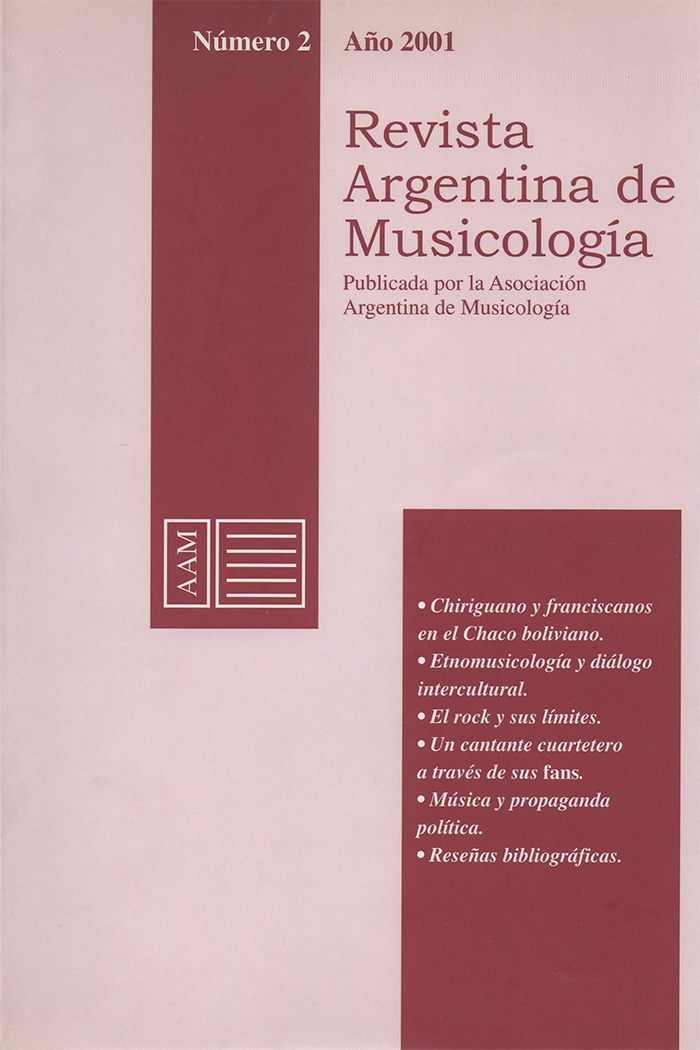
The Bolivian Chiriguano are one of the few American native groups that managed to hold on to a relative autonomy throughout the colonial and early republican times, until they were finally forced to submit towards the end of the 19'h century. Colonial and republican advance operated in different ways; an important one was spearheaded by the Franciscans with the settlement of missions in Chiriguano territories from the mid 18'h century on. Once the missions were firmly rooted, the missionary project attempted not only to integrate the aborigines to the "society with enforcement" and their Christianization, but also to control their main cultural artifacts, like sound, time and space. In fact, both Europeans and Natives were well aware that "sound'', " noise" and "silence" were a source of power and knowledge. This led to a heavyhanded policy aimed at wiping them out, something that in turn led to deep processes of change within the Chiriguano world of sounds.
Downloads
Downloads
Published
Issue
Section
License
Copyright (c) 2001 Revista Argentina de Musicología

This work is licensed under a Creative Commons Attribution-NonCommercial 4.0 International License.
Attribution-NonCommercial 4.0 International
Licencia Creative Commons Atribución-NoComercial 4.0
You are free to:
- Share — copy and redistribute the material in any medium or format.
- Adapt — remix, transform, and build upon the material.
- The licensor cannot revoke these freedoms as long as you comply with the terms of the license
Under the following terms:
- Attribution — You must give appropriate credit, provide a link to the license, and indicate if changes were made. You may do so in any reasonable manner, but not in a way that suggests that you or your use are endorsed by the licensor.
- Noncommercial — You may not use the material for commercial purposes.
- No Additional Restrictions — You may not apply legal terms or technological measures that legally restrict others from making any use permitted by the license.
Notices:
You do not have to comply with the license for elements of the material that are in the public domain or when your use is permitted by an applicable exception or limitation.
No warranties are provided. The license may not grant you all the permissions you need for your intended use. For example, other rights—such as publicity, privacy, or moral rights—may limit how you use the material.