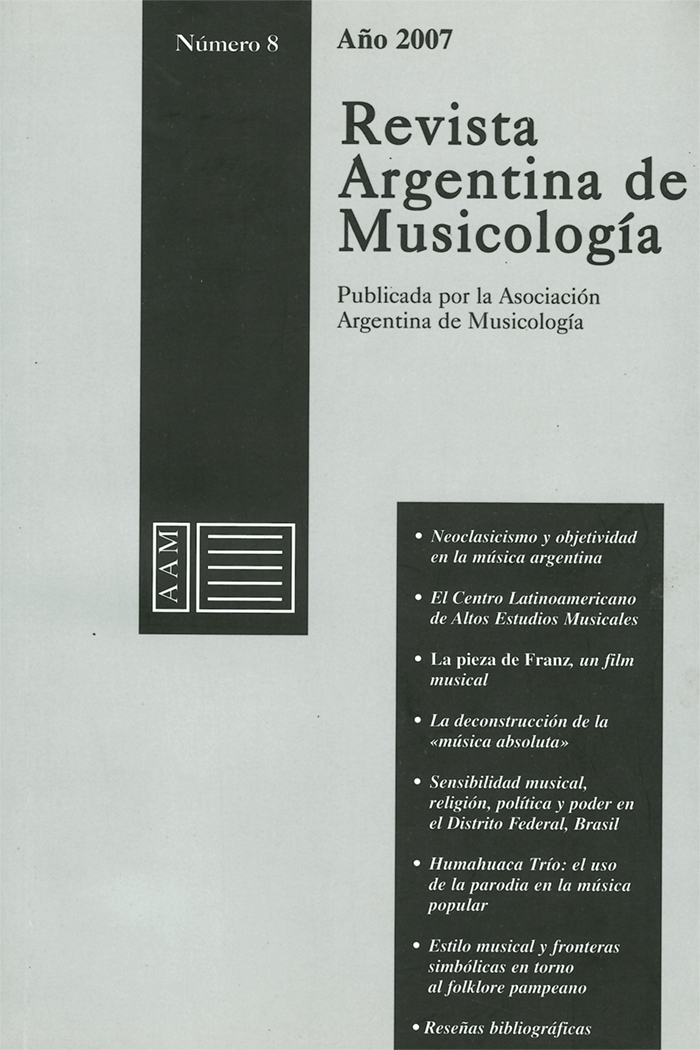
Humahuaca Trio: the use of parody in popular music.
Abstract
Different aspects of Humahuaca Trio's musical works are described and analyzed. In its repertory there is a fusion of several expressions of the so called folk music with rock and ska. The working hipothesis is that this group makes use of parody for producing a convergence among various musical genres. Parody is brounght into play not only in the fusion of different languages and themes, but also in the instrumentation and in the lyrics of the songs. Likewise it is claimed that parody in literary and musical fields is essentially a type of critique from a humorous perspective. So Humahuaca Trio identifies a set of stereotypes belonging to culture of Jujuy. The musical group criticizes life conditions produced by globalization in the Quebrada and Puna regions.
Downloads
Downloads
Published
Issue
Section
License
Copyright (c) 2018 Asociación Argentina de Musicología

This work is licensed under a Creative Commons Attribution-NonCommercial 4.0 International License.
Attribution-NonCommercial 4.0 International
Licencia Creative Commons Atribución-NoComercial 4.0
You are free to:
- Share — copy and redistribute the material in any medium or format.
- Adapt — remix, transform, and build upon the material.
- The licensor cannot revoke these freedoms as long as you comply with the terms of the license
Under the following terms:
- Attribution — You must give appropriate credit, provide a link to the license, and indicate if changes were made. You may do so in any reasonable manner, but not in a way that suggests that you or your use are endorsed by the licensor.
- Noncommercial — You may not use the material for commercial purposes.
- No Additional Restrictions — You may not apply legal terms or technological measures that legally restrict others from making any use permitted by the license.
Notices:
You do not have to comply with the license for elements of the material that are in the public domain or when your use is permitted by an applicable exception or limitation.
No warranties are provided. The license may not grant you all the permissions you need for your intended use. For example, other rights—such as publicity, privacy, or moral rights—may limit how you use the material.