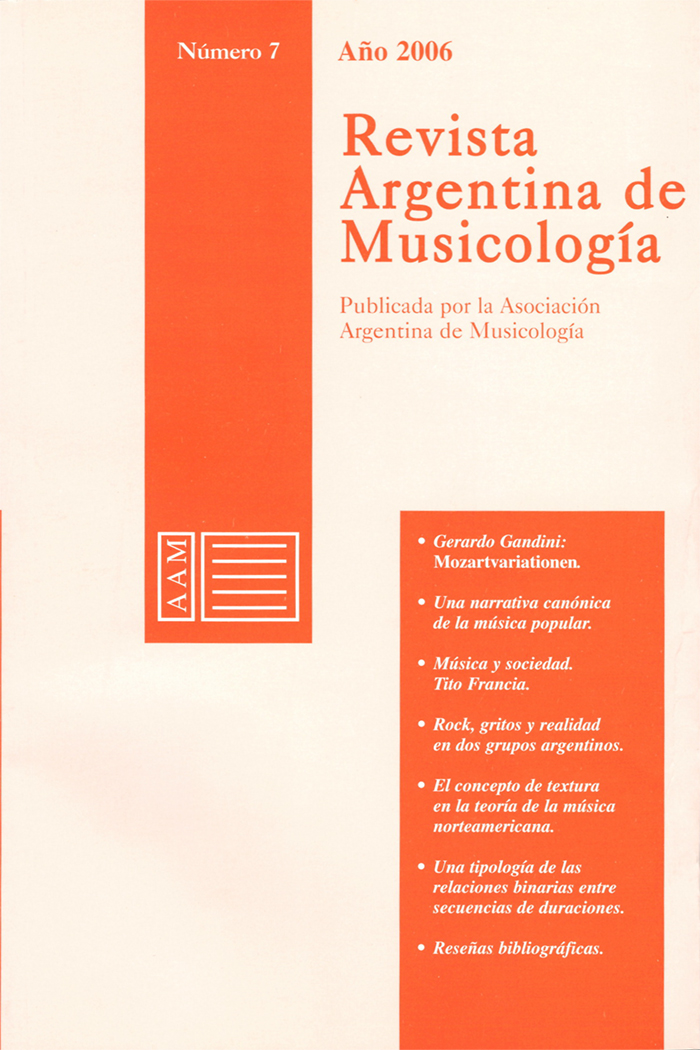
A canonical narrative of popular music: 100 years after Robert Lehmann-Nitsche recordings.
Keywords:
Robert Lehmann-NietscheAbstract
The earliest large collection of aboriginal and popular music in Argentina was carried out by Robert Lehmann-Nitsche between 1905 and 1909. The German researcher was convinced that he was dealing with very exotic musical expressions, which were threatened by urbanization and industrialization processes. Consequently he recorded 242 wax cylinders, currently part of the collection of the Phonogramm-Archiv in Berlín. His reified perspective. that defined musical expressions as if they were storable objects. influenced the musical studies made by local researchers who came after him. The critical observation of his method may throw light on to what extent his epistemology had an influence on the local canon, leading many later researches, consciously or unconsciously, to follow the same premises Lehmann-Nitsche applied.
Downloads
Downloads
Published
Issue
Section
License
Copyright (c) 2018 Asociación Argentina de Musicología

This work is licensed under a Creative Commons Attribution-NonCommercial 4.0 International License.
Attribution-NonCommercial 4.0 International
Licencia Creative Commons Atribución-NoComercial 4.0
You are free to:
- Share — copy and redistribute the material in any medium or format.
- Adapt — remix, transform, and build upon the material.
- The licensor cannot revoke these freedoms as long as you comply with the terms of the license
Under the following terms:
- Attribution — You must give appropriate credit, provide a link to the license, and indicate if changes were made. You may do so in any reasonable manner, but not in a way that suggests that you or your use are endorsed by the licensor.
- Noncommercial — You may not use the material for commercial purposes.
- No Additional Restrictions — You may not apply legal terms or technological measures that legally restrict others from making any use permitted by the license.
Notices:
You do not have to comply with the license for elements of the material that are in the public domain or when your use is permitted by an applicable exception or limitation.
No warranties are provided. The license may not grant you all the permissions you need for your intended use. For example, other rights—such as publicity, privacy, or moral rights—may limit how you use the material.