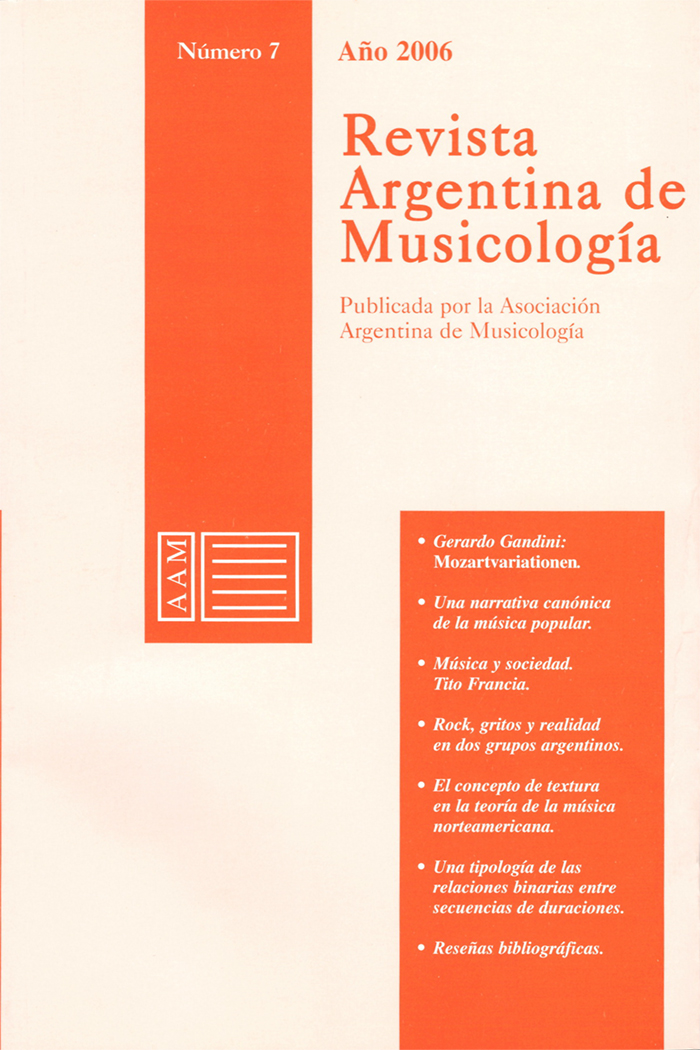
A typology of binary relationships between sequences of durations.
Keywords:
análisis rítmico, relaciones entre secuencias de duraciones, Análisis musical asistido por computadoraAbstract
In this paper I present a typology of musical binary relationships between sequences of durations. First, I define some theoretical concepts. These relationships are classified in two main categories: total match and similarity. In the first group there is identity, permutation, pseudo-permutation, delta (augmentation-diminution) division and addition. Similarity relationshlps exist when we found total match relationships between subsequences. Then we present an implementation or this theory in Common Lisp. wc show the analysis functions that correspond to cvery relationship. and we explain the formal or the results. Next I illustrate these relationships "in context'' with musical examples ranging from Middle Ages to the present. In the end. I postulate that the presence of these relationships in the history of Western music allows to assign them the category of fundamental components of rhythmic thought.
Downloads
Downloads
Published
Issue
Section
License
Copyright (c) 2018 Asociación Argentina de Musicología

This work is licensed under a Creative Commons Attribution-NonCommercial 4.0 International License.
Attribution-NonCommercial 4.0 International
Licencia Creative Commons Atribución-NoComercial 4.0
You are free to:
- Share — copy and redistribute the material in any medium or format.
- Adapt — remix, transform, and build upon the material.
- The licensor cannot revoke these freedoms as long as you comply with the terms of the license
Under the following terms:
- Attribution — You must give appropriate credit, provide a link to the license, and indicate if changes were made. You may do so in any reasonable manner, but not in a way that suggests that you or your use are endorsed by the licensor.
- Noncommercial — You may not use the material for commercial purposes.
- No Additional Restrictions — You may not apply legal terms or technological measures that legally restrict others from making any use permitted by the license.
Notices:
You do not have to comply with the license for elements of the material that are in the public domain or when your use is permitted by an applicable exception or limitation.
No warranties are provided. The license may not grant you all the permissions you need for your intended use. For example, other rights—such as publicity, privacy, or moral rights—may limit how you use the material.