The present state of musical expressions in the Quebrada de Humauaca and the Puna region (Jujuy)
Abstract
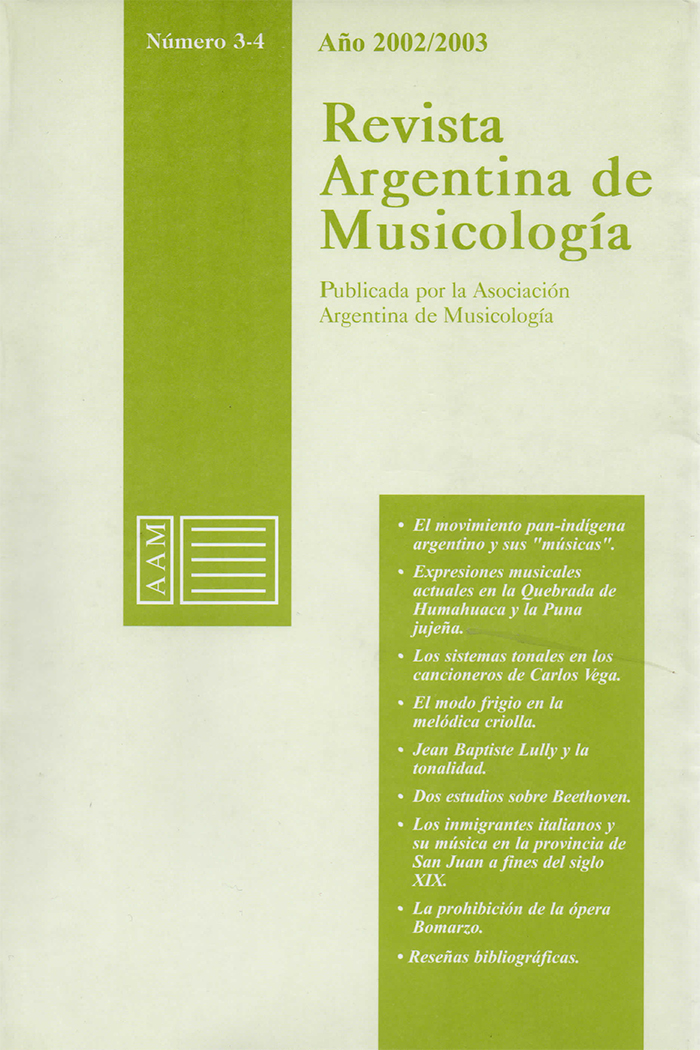
This paper attempts to offer an overview of the sounding landscape of the Quebrada de Humahuaca and the Puna region in Jujuy and West Salta (Argentina) over the period between 1985 to 1997. with some additional observations taken during 2003. The study is based upon the local inhabitants' own classification of the music played and consumed in the arca, that is, a) music “para adorar" or for worshipping, and b) music for dancing or entertainment. Their views regarding which music is deemed as ''folk music" and which merits a special taxonomy, such as the case of the coplas or bagualas is also taken into consideration. The situation of “música para adorar" or music for worshipping, an ostensibly conflictless one. as well as that of the complex second group are presented. Even though it can be observed that globalization. both economic and cultural. has affected all the regions to a certain extent and has accelerated the change rate. the question of change itself is a problematic one since most of previous musicological research was conducted exclusively from the viewpoint of the researcher, that is. seeking the folk community according to Cortazar's definition and oblivious to any expression that fell outside of that theoretical model. Hence. it would be important to reconstruct the performance and usage of non-traditional sound expressions in the area during the past decades. The paper closes with a proposal for exploring new research topics based on more updated approaches
Downloads
Downloads
Published
Issue
Section
License
Copyright (c) 2018 Asociación Argentina de Musicología

This work is licensed under a Creative Commons Attribution-NonCommercial 4.0 International License.
Attribution-NonCommercial 4.0 International
Licencia Creative Commons Atribución-NoComercial 4.0
You are free to:
- Share — copy and redistribute the material in any medium or format.
- Adapt — remix, transform, and build upon the material.
- The licensor cannot revoke these freedoms as long as you comply with the terms of the license
Under the following terms:
- Attribution — You must give appropriate credit, provide a link to the license, and indicate if changes were made. You may do so in any reasonable manner, but not in a way that suggests that you or your use are endorsed by the licensor.
- Noncommercial — You may not use the material for commercial purposes.
- No Additional Restrictions — You may not apply legal terms or technological measures that legally restrict others from making any use permitted by the license.
Notices:
You do not have to comply with the license for elements of the material that are in the public domain or when your use is permitted by an applicable exception or limitation.
No warranties are provided. The license may not grant you all the permissions you need for your intended use. For example, other rights—such as publicity, privacy, or moral rights—may limit how you use the material.