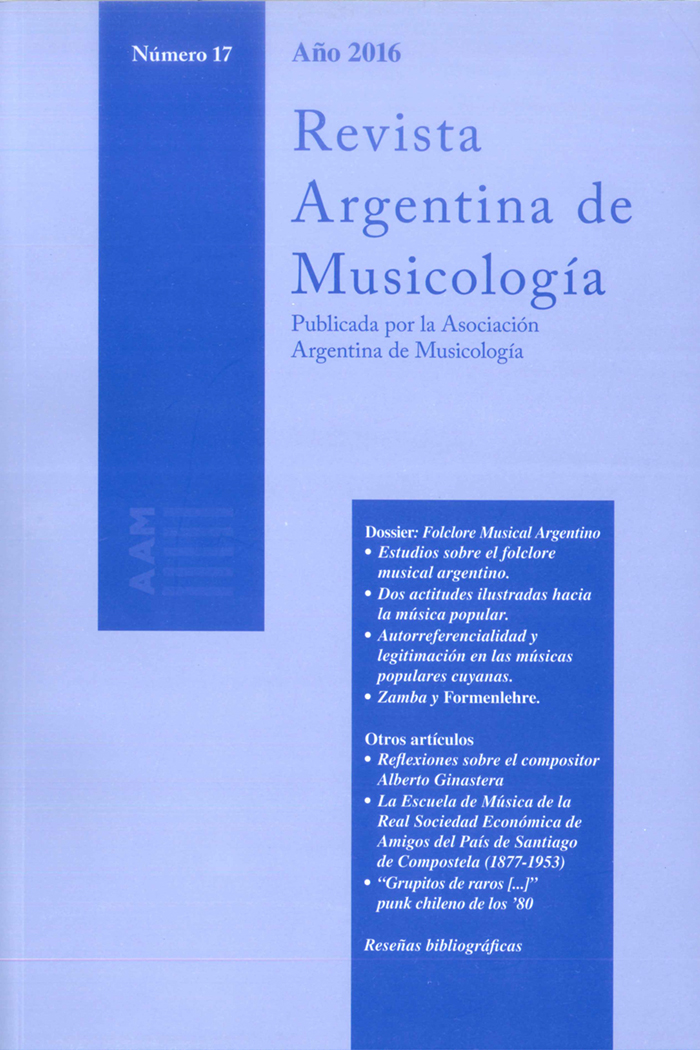
Zamba and Formelehre: a Formal Approach of the Zamba in Dialogue with Some Recent Trends in Music Theory
Keywords:
zamba, music analysis, formal function, modular-form, Wiliam CaplinAbstract
In this paper we study the formal organization in the zamba genre, using a formal-functional approach as presented by William Caplin and other authors. We present a modular formal-functional model of the zamba also inspired by James Hepokoski and Warren Darcy’s Sonata Theory. We analyze and discuse several musical examples that show various intra-thematic formal alternatives of the zamba. Finally, the first stanza of two well known zambas, Debajo de la morera and Zamba del riego are analyzed in detail, incorporating the prolongational graphs proposed by Lerdahl and Jackendoff.
Downloads
Downloads
Published
Issue
Section
License
Copyright (c) 2016 Alejandro Martínez

This work is licensed under a Creative Commons Attribution-NonCommercial 4.0 International License.
Attribution-NonCommercial 4.0 International
Licencia Creative Commons Atribución-NoComercial 4.0
You are free to:
- Share — copy and redistribute the material in any medium or format.
- Adapt — remix, transform, and build upon the material.
- The licensor cannot revoke these freedoms as long as you comply with the terms of the license
Under the following terms:
- Attribution — You must give appropriate credit, provide a link to the license, and indicate if changes were made. You may do so in any reasonable manner, but not in a way that suggests that you or your use are endorsed by the licensor.
- Noncommercial — You may not use the material for commercial purposes.
- No Additional Restrictions — You may not apply legal terms or technological measures that legally restrict others from making any use permitted by the license.
Notices:
You do not have to comply with the license for elements of the material that are in the public domain or when your use is permitted by an applicable exception or limitation.
No warranties are provided. The license may not grant you all the permissions you need for your intended use. For example, other rights—such as publicity, privacy, or moral rights—may limit how you use the material.