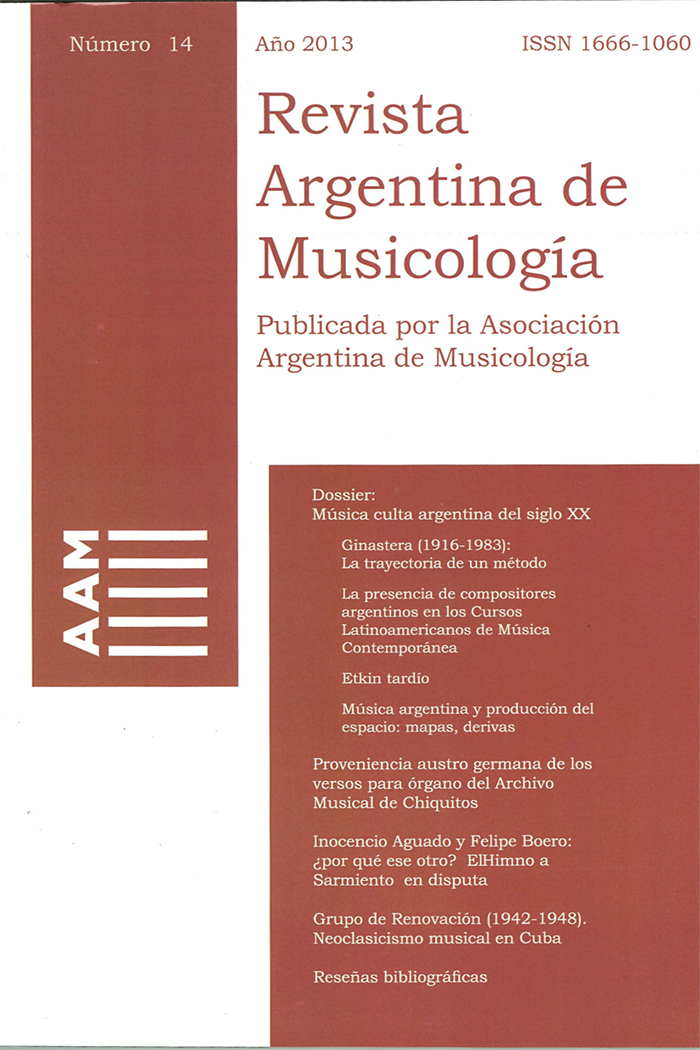
Grupo de Renovación (1942-1948). Musical Neoclassicism in Cuba.
Keywords:
neoclassicism, Hispanicity, Afrocubanism, group, identityAbstract
The history of musical neoclassicism in Cuba can be traced to 1942, when a group of composers created the Grupo de Renovación with the intention of challenging the aesthetic preferences of an audience that cultivated music as part of Havana’s sophisticated social life. The aims and actions of the Grupo de Renovación should be understood as an intellectual stance that mirrored the musical thinking of its time. Its fundamental purpose was to insert Cuban music into the mainstream of the written tradition of Western art music. Neoclassicism, understood as a modern type of eclecticism, implies the presence of folk strands in compositions by Latin Americans that rely on the scaffoldings of Western art music genres as a principal strategy to establish difference. How do Cuban composers define neoclassicism and how does musicology reconcile national identity (Hispanicity and Afrocubanism), postcolonial and neocolonial thought, external influences, and transgression of classical paradigms? How does the incorporation of Afrocuban sounds into classical sonata forms function in contemporary concert music?
Downloads
Downloads
Published
Issue
Section
License
Copyright (c) 2018 Asociación Argentina de Musicología

This work is licensed under a Creative Commons Attribution-NonCommercial 4.0 International License.
Attribution-NonCommercial 4.0 International
Licencia Creative Commons Atribución-NoComercial 4.0
You are free to:
- Share — copy and redistribute the material in any medium or format.
- Adapt — remix, transform, and build upon the material.
- The licensor cannot revoke these freedoms as long as you comply with the terms of the license
Under the following terms:
- Attribution — You must give appropriate credit, provide a link to the license, and indicate if changes were made. You may do so in any reasonable manner, but not in a way that suggests that you or your use are endorsed by the licensor.
- Noncommercial — You may not use the material for commercial purposes.
- No Additional Restrictions — You may not apply legal terms or technological measures that legally restrict others from making any use permitted by the license.
Notices:
You do not have to comply with the license for elements of the material that are in the public domain or when your use is permitted by an applicable exception or limitation.
No warranties are provided. The license may not grant you all the permissions you need for your intended use. For example, other rights—such as publicity, privacy, or moral rights—may limit how you use the material.