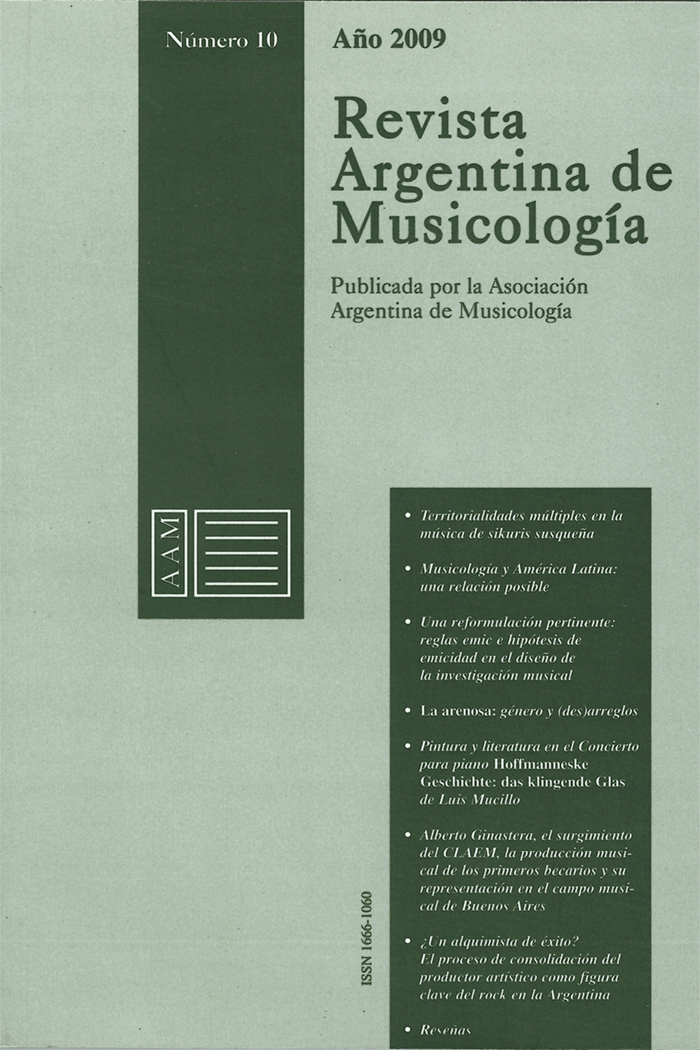
A pertinent reformulation: the emic rules and the hypothesis of emicity in the design of music research.
Keywords:
emic/etic, ethnomusicology, music analysis, Estancia La CandelariaAbstract
The etic perspective suggests the infallibility of the researcher’s judgments on his study material. The emic approach, on the other hand, indicates the need to incorporate the perspective of the insiders so as to perceive their thoughts on their music. However, who can guarantee that the translation of the insider’s perspective into the researcher’s terms is correct? What does the suitability of an emic description rely on? On pragmatics? Or on the blind trust in the informants? Moreover, what are the limits of the ethical perspective? Is this the only possible place to develop the theory? Does its suitability rest on pragmatics or on the blind trust of our own assumptions? These epistemological questions about emic/etic can be answered if the epistemological status of every perspective during the process of designing the musical research is reformulated. On the latter question the following article lies: Its aim is to develop the proposal that emic perspective works as rules to be validated, while the etic perspective makes it possible to formulate emicity hypotheses to be verified. The studycase is the way the insiders in Estancia La Candelaria (Province of Córdoba) sing. The singing shows rhythmic variations derived from the regional accent according to the performance’s particular circumstances.
Downloads
Downloads
Published
Issue
Section
License
Copyright (c) 2018 Asociación Argentina de Musicología

This work is licensed under a Creative Commons Attribution-NonCommercial 4.0 International License.
Attribution-NonCommercial 4.0 International
Licencia Creative Commons Atribución-NoComercial 4.0
You are free to:
- Share — copy and redistribute the material in any medium or format.
- Adapt — remix, transform, and build upon the material.
- The licensor cannot revoke these freedoms as long as you comply with the terms of the license
Under the following terms:
- Attribution — You must give appropriate credit, provide a link to the license, and indicate if changes were made. You may do so in any reasonable manner, but not in a way that suggests that you or your use are endorsed by the licensor.
- Noncommercial — You may not use the material for commercial purposes.
- No Additional Restrictions — You may not apply legal terms or technological measures that legally restrict others from making any use permitted by the license.
Notices:
You do not have to comply with the license for elements of the material that are in the public domain or when your use is permitted by an applicable exception or limitation.
No warranties are provided. The license may not grant you all the permissions you need for your intended use. For example, other rights—such as publicity, privacy, or moral rights—may limit how you use the material.