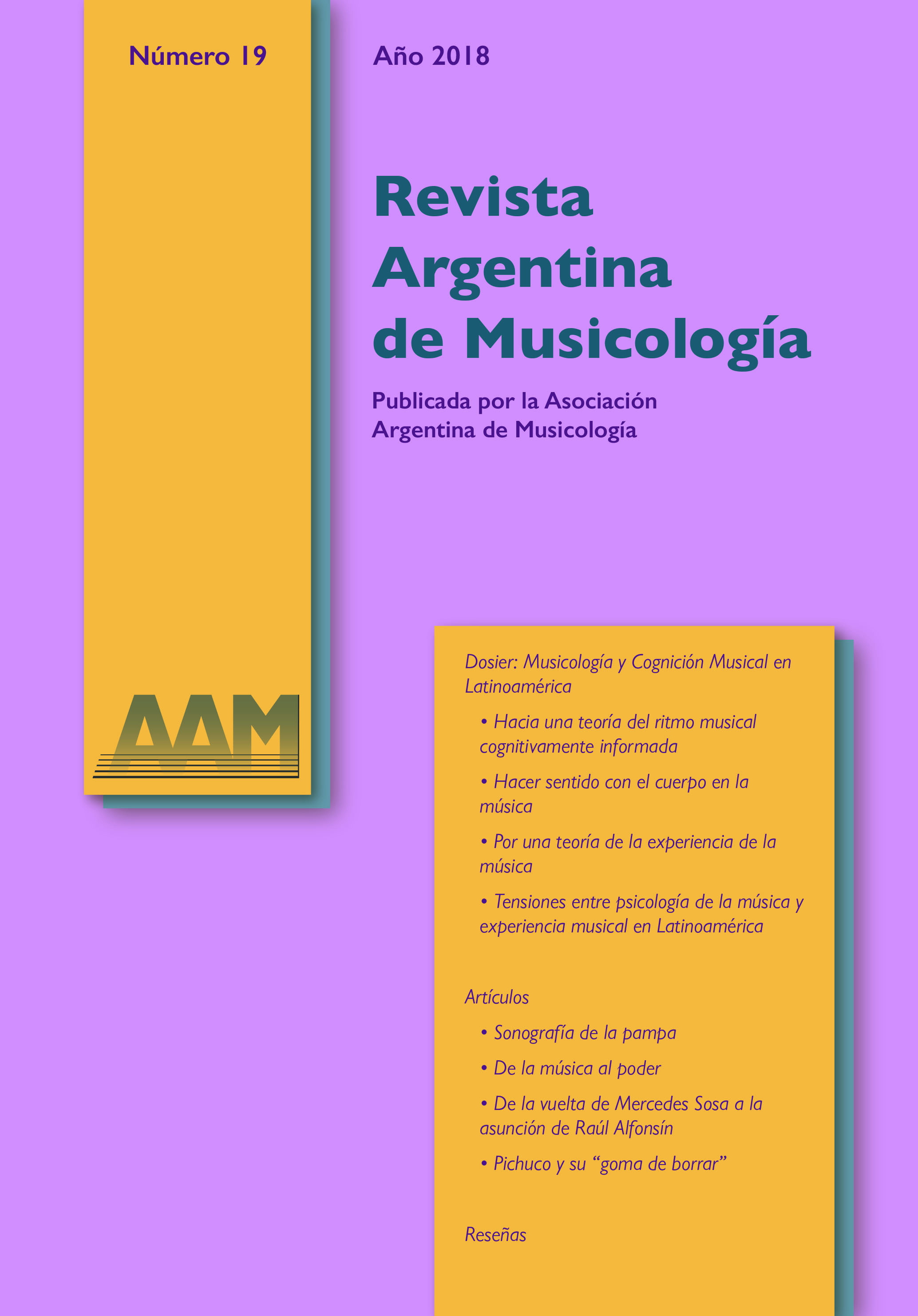
Pichuco and his “eraser”: differences between text and execution in a tango arranged by Astor Piazzolla for the typical Aníbal Troilo orchestra
Keywords:
arrangements, performance practice, modernity, topics, golden ageAbstract
In the introduction of a tango interpreted by Aníbal Troilo and his typical orchestra, I aurally recognize the use of the topos of the guitar. When I access the manuscript of that arrangement, I discover that the introduction was crossed out and that the original writing differs from the recorded performance. When verifying that the arrangement is signed by Astor Piazzolla and that in the historiographies he does not appear as the author, I become aware that it is a primary source of great testimonial value. The contrast of the text and its secondary annotations with its two recorded versions, have diversified the research and redefined the initial object of study. What in principle was an analytical approach to a compositional resource, becomes a journey through various research methodologies that the document proposes.
This article is a case study on the operation of the arrangement and the interpretive praxis in the typical tango orchestra. Troilo as director and Piazzolla as arranger, two of the most important musicians in the history of the genre, are studied in this work providing significant information on the reception and conformation of tango styles in his golden age
Downloads
Downloads
Published
Issue
Section
License
Copyright (c) 2019 Asociación Argentina de Musicología

This work is licensed under a Creative Commons Attribution-NonCommercial 4.0 International License.
Attribution-NonCommercial 4.0 International
Licencia Creative Commons Atribución-NoComercial 4.0
You are free to:
- Share — copy and redistribute the material in any medium or format.
- Adapt — remix, transform, and build upon the material.
- The licensor cannot revoke these freedoms as long as you comply with the terms of the license
Under the following terms:
- Attribution — You must give appropriate credit, provide a link to the license, and indicate if changes were made. You may do so in any reasonable manner, but not in a way that suggests that you or your use are endorsed by the licensor.
- Noncommercial — You may not use the material for commercial purposes.
- No Additional Restrictions — You may not apply legal terms or technological measures that legally restrict others from making any use permitted by the license.
Notices:
You do not have to comply with the license for elements of the material that are in the public domain or when your use is permitted by an applicable exception or limitation.
No warranties are provided. The license may not grant you all the permissions you need for your intended use. For example, other rights—such as publicity, privacy, or moral rights—may limit how you use the material.