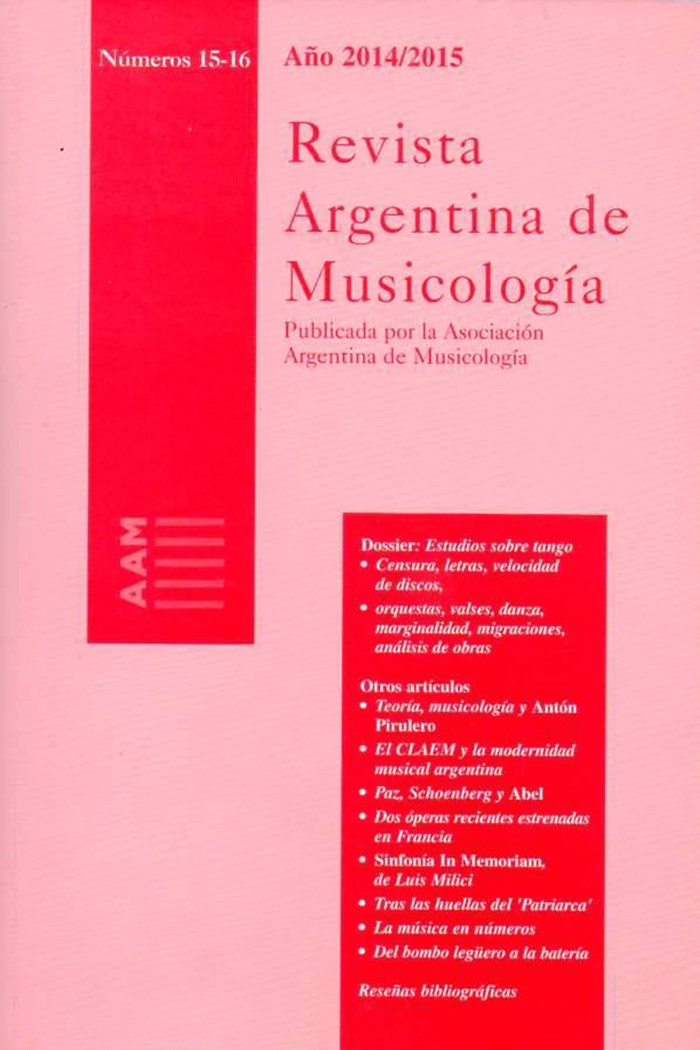
Following in the Footsteps of the “Patriarch”: The review La Quena as a vehicle for understanding the persona and aesthetic of Alberto Williams.
Keywords:
La Quena review, Alberto Williams, canon and hegemonyAbstract
This article examines some of the mechanisms through which the composer Alberto Williams managed to insert himself into the national canon as “the patriarch of Argentinian music”. We will follow Dahlhaus, who proposes that the criteria for “authenticity” (of nationalism) can be found in historical processes and functions rather than in the aesthetic criteria of composition. In this context, the study of La Quena (1919-1936) –a largely unexplored source that promoted activity of the Conservatorio de Música de Buenos Aires– attempts to answer questions that go beyond the traditional field of music production.
In this paper, we attempt to show that Williams’ place in the canon has most likely been generated by the articulation of a dual mechanism of legitimation: first, the founding and management of the Conservatorio de Música de Buenos Aires; second, the use of the press. In this sense, just as Anderson emphasizes the importance of the press’s role in the formation of a nationalist consciousness in the “Imagined Communities”, we too consider that, in Williams’ personal trajectory, the road to recognition may have been touched by the indelible mark of the press –the metonymy of nationality and modernity–.
Downloads
Downloads
Published
Issue
Section
License
Copyright (c) 2018 Asociación Argentina de Musicología

This work is licensed under a Creative Commons Attribution-NonCommercial 4.0 International License.
Attribution-NonCommercial 4.0 International
Licencia Creative Commons Atribución-NoComercial 4.0
You are free to:
- Share — copy and redistribute the material in any medium or format.
- Adapt — remix, transform, and build upon the material.
- The licensor cannot revoke these freedoms as long as you comply with the terms of the license
Under the following terms:
- Attribution — You must give appropriate credit, provide a link to the license, and indicate if changes were made. You may do so in any reasonable manner, but not in a way that suggests that you or your use are endorsed by the licensor.
- Noncommercial — You may not use the material for commercial purposes.
- No Additional Restrictions — You may not apply legal terms or technological measures that legally restrict others from making any use permitted by the license.
Notices:
You do not have to comply with the license for elements of the material that are in the public domain or when your use is permitted by an applicable exception or limitation.
No warranties are provided. The license may not grant you all the permissions you need for your intended use. For example, other rights—such as publicity, privacy, or moral rights—may limit how you use the material.