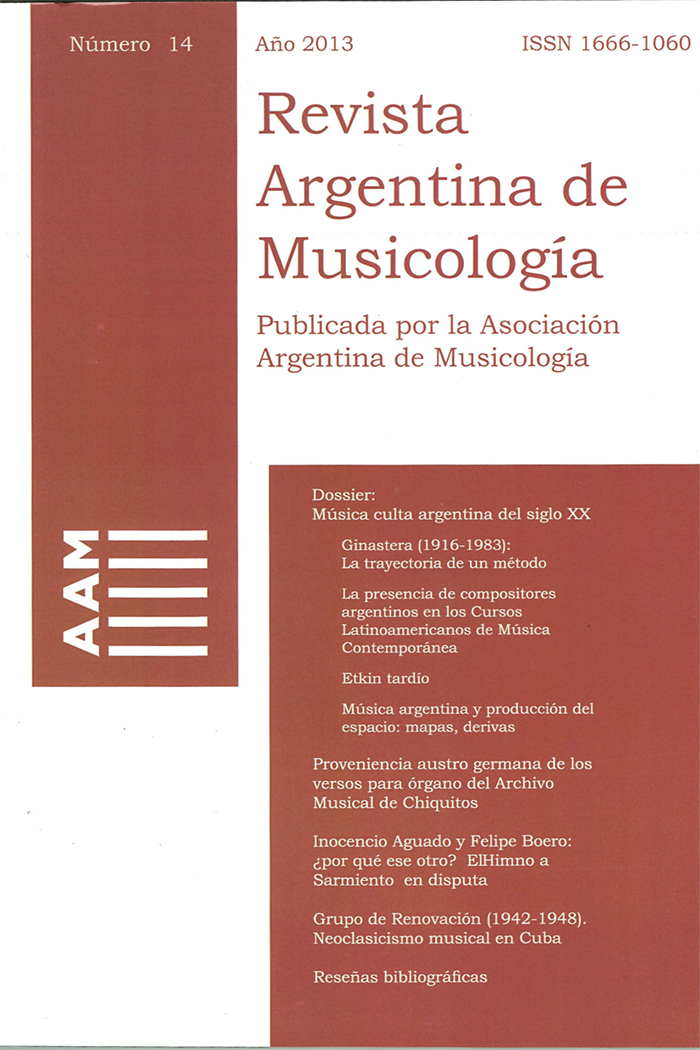
Ginastera (1916–1983): The progress of a method.
Keywords:
Alberto Ginastera, Segundo Cuarteto de Cuerdas, Op. 26 (1958), Alban Berg, Lyric Suite (1926), Bearbeitung, analytical systems, sourcesAbstract
In general terms, the musical poetics of Alberto Ginastera (1916–1983) subsumes seminal 20thcentury compositional procedures, which, in turn, served to develop analytical systems based on studies of canonic composers. The labyrinthine interpenetration that emerges from the process of transferring and recomposing materials from one work to another, inherent to the progress of Ginastera’s method, can involve a generative element taken from a previous work or an entire enunciation re-elaborated as metamorphosis, creating a dense web of intratextual relationships, which, projected at different levels of his compositions, turns each presentation into a “work in progress”. From an analysis of the Segundo Cuarteto de Cuerdas (1958) that probes its structural properties, its cryptography, and its dialogical relationships with paradigms of the genre, as well as the quartet’s arrangement or Bearbeitung as Concerto per corde, Op. 33 (1965), this inquiry broadens its scope to other cases of “recomposition” and the analytical systems subtending them in a partial attempt to map the vast intratextual web permeating Ginastera’s creative journey, which itself verifies the congruence between his poetics and the approaches to musical construction that defined modernity in the twentieth century.
Downloads
Downloads
Published
Issue
Section
License
Copyright (c) 2018 Asociación Argentina de Musicología

This work is licensed under a Creative Commons Attribution-NonCommercial 4.0 International License.
Attribution-NonCommercial 4.0 International
Licencia Creative Commons Atribución-NoComercial 4.0
You are free to:
- Share — copy and redistribute the material in any medium or format.
- Adapt — remix, transform, and build upon the material.
- The licensor cannot revoke these freedoms as long as you comply with the terms of the license
Under the following terms:
- Attribution — You must give appropriate credit, provide a link to the license, and indicate if changes were made. You may do so in any reasonable manner, but not in a way that suggests that you or your use are endorsed by the licensor.
- Noncommercial — You may not use the material for commercial purposes.
- No Additional Restrictions — You may not apply legal terms or technological measures that legally restrict others from making any use permitted by the license.
Notices:
You do not have to comply with the license for elements of the material that are in the public domain or when your use is permitted by an applicable exception or limitation.
No warranties are provided. The license may not grant you all the permissions you need for your intended use. For example, other rights—such as publicity, privacy, or moral rights—may limit how you use the material.