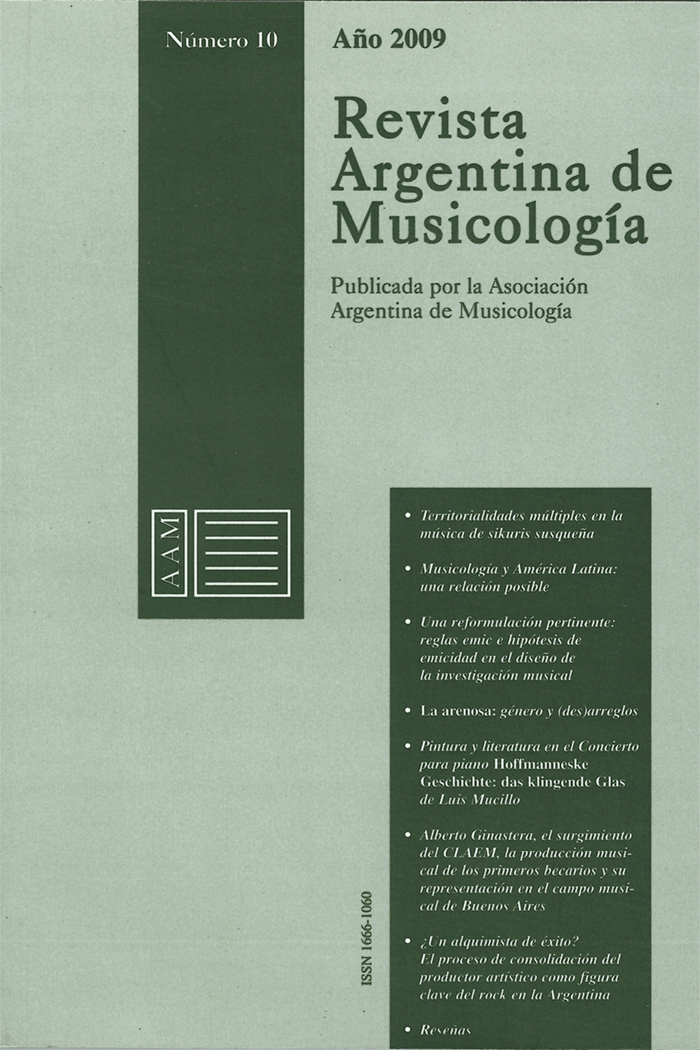
Painting and literature in Luis Mucillo’s Piano Concert Hoffmanneske Geschichte: das klingende Glas.
Keywords:
Mucillo, Klee, Hoffmann, intertext, paintingAbstract
Luis Mucillo’s Piano Concerto, Hoffmanneske Geschichte: das klingende Glas, developed from a piano piece, draws its main inspiration from a painting by Paul Klee which, in turn, points to E. T. A. Hoffmann. Placed in a net of influences that includes, among others, Rilke, Schoenberg, Mozart, and Schumann, this musical work seems particularly appropriate to study the phenomenon of the correspondence between the arts. Based on some interviews with the composer, as well as on a comparative analysis of the Concerto and the pictorial and literary works that contributed to its genesis, this article focuses on the transformation of literary and pictorial elements into musical gestures, techniques and materials, offering an insight into the intertextual relationships that emerge from it.
Downloads
Downloads
Published
Issue
Section
License
Copyright (c) 2018 Asociación Argentina de Musicología

This work is licensed under a Creative Commons Attribution-NonCommercial 4.0 International License.
Attribution-NonCommercial 4.0 International
Licencia Creative Commons Atribución-NoComercial 4.0
You are free to:
- Share — copy and redistribute the material in any medium or format.
- Adapt — remix, transform, and build upon the material.
- The licensor cannot revoke these freedoms as long as you comply with the terms of the license
Under the following terms:
- Attribution — You must give appropriate credit, provide a link to the license, and indicate if changes were made. You may do so in any reasonable manner, but not in a way that suggests that you or your use are endorsed by the licensor.
- Noncommercial — You may not use the material for commercial purposes.
- No Additional Restrictions — You may not apply legal terms or technological measures that legally restrict others from making any use permitted by the license.
Notices:
You do not have to comply with the license for elements of the material that are in the public domain or when your use is permitted by an applicable exception or limitation.
No warranties are provided. The license may not grant you all the permissions you need for your intended use. For example, other rights—such as publicity, privacy, or moral rights—may limit how you use the material.