
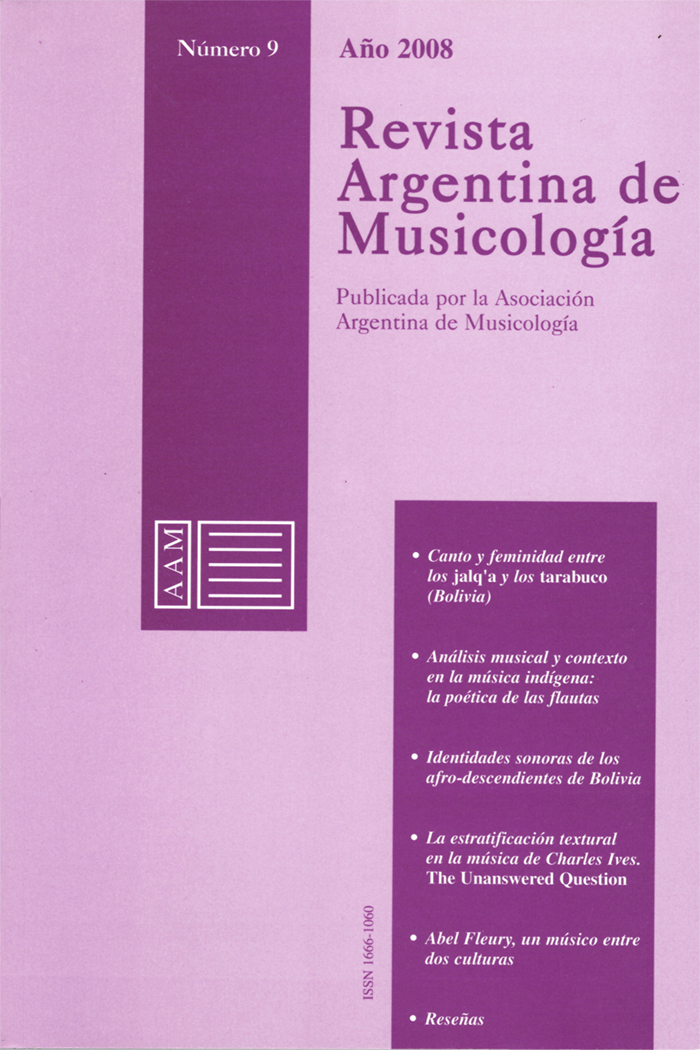
Textural stratification in the music of Charles Ives. An analysis of The Unanswered Question (1906-1930/35).
Keywords:
Charles E. Ives, texture, stratification, heterogeneity, The Unanswered QuestionAbstract
The textural stratification in the music of Charles E. Ives hinges on a marked individuation of the elements that make up the texture. Such individuation results from the materials being elaborated with independence of the totality they conform, but no longer governs them. Textura! stratification can thus be understood as an immanent criticism to the binding character of tonality, to its status as a regulatory element of music in general and as a foundation for the logic of simultaneity in particular. A combination of elements such as heterogeneity and individuation of materials, stratification associated with a disintegrated simultaneity, and the treatment of tonality as a dehistorized material are noticeable in The Unanswered Question, a work Ives composed between 1906 and 1930/35.
Downloads
Downloads
Published
Issue
Section
License
Copyright (c) 2018 Asociación Argentina de Musicología

This work is licensed under a Creative Commons Attribution-NonCommercial 4.0 International License.
Attribution-NonCommercial 4.0 International
Licencia Creative Commons Atribución-NoComercial 4.0
You are free to:
- Share — copy and redistribute the material in any medium or format.
- Adapt — remix, transform, and build upon the material.
- The licensor cannot revoke these freedoms as long as you comply with the terms of the license
Under the following terms:
- Attribution — You must give appropriate credit, provide a link to the license, and indicate if changes were made. You may do so in any reasonable manner, but not in a way that suggests that you or your use are endorsed by the licensor.
- Noncommercial — You may not use the material for commercial purposes.
- No Additional Restrictions — You may not apply legal terms or technological measures that legally restrict others from making any use permitted by the license.
Notices:
You do not have to comply with the license for elements of the material that are in the public domain or when your use is permitted by an applicable exception or limitation.
No warranties are provided. The license may not grant you all the permissions you need for your intended use. For example, other rights—such as publicity, privacy, or moral rights—may limit how you use the material.