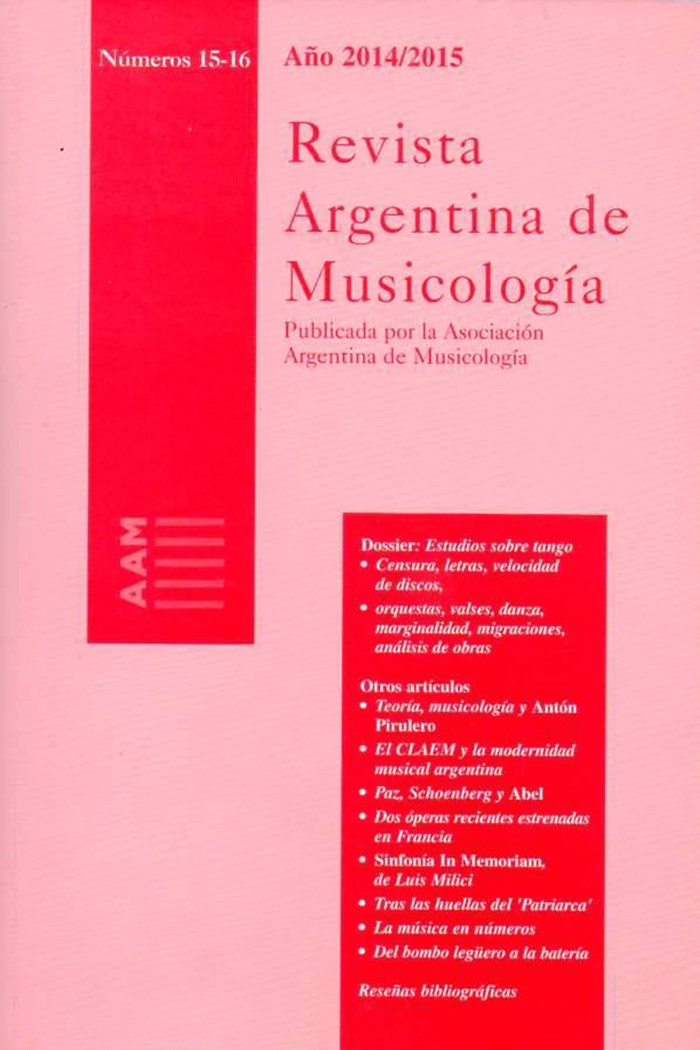
The CLAEM and the Argentine Musical Modernity.
Keywords:
CLAEM, Argentine musical modernity, Gandini, Etkin, AriasAbstract
Until the emergence of the Latin American Centre for Advanced Musical Studies (CLAEM at the Di Tella Institute), Argentine musical scene could be explained around two almost mutually exclusive tendencies; on the one hand, the musical nationalism with A. Ginastera as its most conspicuous exponent, and on the other, the internationalist one led by J. C. Paz. Both related to a greater or lesser extent with their European counterparts and established models: Ginastera nationalism through Argentine folklore (until at least the fifties) and Paz paradigmatically with Viennese 12-tone music in the thirties and later with the generalization of the serial principle. In this context, the CLAEM produced the dissolution of the historical antinomy and established a so far unknown aesthetic multiplicity. In this work we propose that the generation directly formed in, or directly related to, the Centre carried out the most important aesthetic transformation of Argentine contemporary academic music from the second half of the 20th Century. Our goal is to describe the nature of this transformation and exemplify it analytically in three pieces by representative composers: ...piagne e sospira (1969), by G. Gandini (1936-2013), Música ritual (1971-1974), by M. Etkin (1943) and Ricercare’s blues (1976), by L. Arias (1940).
Downloads
Downloads
Published
Issue
Section
License
Copyright (c) 2018 Asociación Argentina de Musicología

This work is licensed under a Creative Commons Attribution-NonCommercial 4.0 International License.
Attribution-NonCommercial 4.0 International
Licencia Creative Commons Atribución-NoComercial 4.0
You are free to:
- Share — copy and redistribute the material in any medium or format.
- Adapt — remix, transform, and build upon the material.
- The licensor cannot revoke these freedoms as long as you comply with the terms of the license
Under the following terms:
- Attribution — You must give appropriate credit, provide a link to the license, and indicate if changes were made. You may do so in any reasonable manner, but not in a way that suggests that you or your use are endorsed by the licensor.
- Noncommercial — You may not use the material for commercial purposes.
- No Additional Restrictions — You may not apply legal terms or technological measures that legally restrict others from making any use permitted by the license.
Notices:
You do not have to comply with the license for elements of the material that are in the public domain or when your use is permitted by an applicable exception or limitation.
No warranties are provided. The license may not grant you all the permissions you need for your intended use. For example, other rights—such as publicity, privacy, or moral rights—may limit how you use the material.