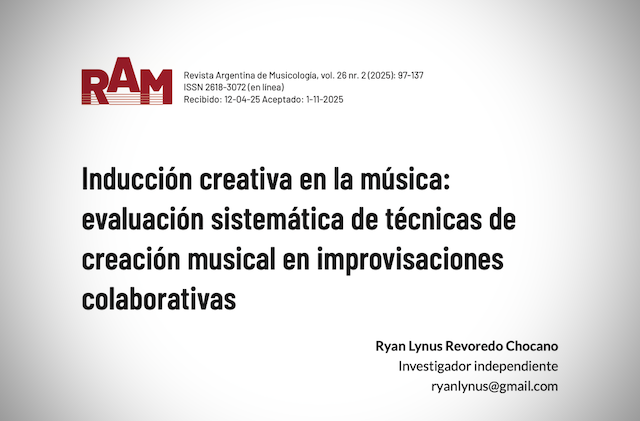
Creative Induction in Music: Systematic Evaluation of Musical Creation Techniques in Collaborative Improvisations
Keywords:
musical creativity, collaboration strategies, music structure, collective music, generative improvisationAbstract
This study evaluates the induction of Musical Creation Techniques (Técnicas de Creación Musical, TCM) in improvisation and collective creation groups, through the identification of characteristics in the musical creations recorded in audio and the aspects of their production. TCM are a set of strategies that apply concepts of structural optimization, timing, and perceptual balance, designed for the coordination of musicians in an improvisation or collaboration, favoring the collective musical arrangement based on individual resources. Between 2006 and 2018, TCM were implemented in workshops and public performances involving 400 participants, from amateurs to professionals, in urban and community settings. As evidence, 1,142 musical creations recorded in audio were produced, which were classified and analyzed based on their achievement of structural coherence. To evaluate creative production, criteria used in computational creativity are incorporated here, including the SPECS procedure, linguistic evaluation, and other contributions related to creative production. The findings confirm that TCMs promote structured improvisation, allowing both novice and experienced musicians to create appealing musical pieces on the spot. This analysis provides evidence regarding the optimized structures proposed in theory, which foster group musical creativity through cooperation tactics.
Editorial History:
Received: April 12, 2025
Accepted: November 1, 2025
Downloads
References
Baker, Geoffrey. “El Sistema, 'The Venezuelan Musical Miracle': The Construction of a Global Myth.” Latin American Music Review 39, no. 2 (2018): 160–193. https://www.muse.jhu.edu/article/717148.
Berliner, Paul F. Thinking in Jazz: The Infinite Art of Improvisation. Chicago: University of Chicago Press, 1994.
Brown, Andrew R., and Andrew Sorensen. “Interacting with Generative Music through Live Coding.” Contemporary Music Review 28, no. 1 (2008): 17–29. https://doi.org/10.1080/07494460802663991.
Choi, Aywon. “Jazz Harmonic Analysis as Optimal Tonality Segmentation.” Computer Music Journal 35, no. 2 (2011): 49–66. http://www.jstor.org/stable/41241722.
Costa, Rogério. “Free Improvisation and the Philosophy of Gilles Deleuze.” Perspectives of New Music 49, no. 1 (2012): 175–205.
Eigenfeldt, Arne, Adam Burnett, and Philippe Pasquier. “Evaluating Musical Metacreation in a Live Performance Context.” In Proceedings of the International Conference on Computational Creativity, 140–44. Dublin, Ireland, 2012.
Faraco, Arthur. “Perception of Structure in Collective Free Improvisation and Its Context Dependency: An Exploratory Analysis.” Empirical Musicology Review 18, no. 1–2 (2023): 45–63. https://doi.org/10.18061/emr.v18i1-2.8875.
Faber, Sarah E. M., and Anthony R. McIntosh. “Toward a Standard Model of Musical Improvisation.” European Journal of Neuroscience 50, no. 3 (2019): 2657–74. https://doi.org/10.1111/ejn.14567.
Gillon, Laurie. “Varieties of Freedom in Music Improvisation.” Open Cultural Studies 2, no. 1 (2018): 781–89. https://doi.org/10.1515/culture-2018-0070.
Huron, David. Sweet Anticipation: Music and the Psychology of Expectation. Cambridge, MA: MIT Press, 2006.
Jordanous, Anna. “A Standardized Procedure for Evaluating Creative Systems: Computational Creativity and Its Evaluation in Music.” Cognitive Computation 4, no. 3 (2012): 246–79. https://doi.org/10.1007/s12559-012-9156-1.
Pease, Alison, Daniel Winterstein, and Simon Colton. “Evaluating Machine Creativity.” In Proceedings of the ICCBR 2001 Workshop on Creative System: Approaches to Creativity in Artificial Intelligence and Cognitive Science, edited by C. Bento and A. Cardoso. Washington, DC: Naval Research Laboratory, 2001.
Pressing, Jeff. “Improvisation: Methods and Models.” In Generative Processes in Music: The Psychology of Performance, Improvisation, and Composition, edited by John A. Sloboda, 129–78. Oxford: Clarendon Press, 1988.
Rhodes, Mel. “An Analysis of Creativity.” Phi Delta Kappan 42, no. 7 (1961): 305–10.
Schoenberg, Arnold. Tratado de Armonía. Madrid: Real Musical, 1992.
Sawyer, R. Keith. Group Creativity: Music, Theater, Collaboration. Mahwah, NJ: Lawrence Erlbaum Associates, 2003.
Additional Files
Published
Issue
Section
License
Copyright (c) 2026 Ryan Lynus Revoredo Chocano

This work is licensed under a Creative Commons Attribution-NonCommercial 4.0 International License.
Attribution-NonCommercial 4.0 International
https://creativecommons.org/licenses/by-nc/4.0/
You are free to:
- Share — copy and redistribute the material in any medium or format.
- Adapt — remix, transform, and build upon the material.
- The licensor cannot revoke these freedoms as long as you follow the license terms.
Under the following terms:
- Attribution — You must give appropriate credit , provide a link to the license, and indicate if changes were made . You may do so in any reasonable manner, but not in any way that suggests the licensor endorses you or your use.
- Non Commercial — You may not use the material for commercial purposes .
- No additional restrictions — You may not apply legal terms or technological measures that legally restrict others from doing anything the license permits.
Notices:
You do not have to comply with the license for elements of the material in the public domain or where your use is permitted by an applicable exception or limitation .
No warranties are given. The license may not give you all of the permissions necessary for your intended use. For example, other rights such as publicity, privacy, or moral rightsmay limit how you use the material.


 The works included in this magazine are published under the