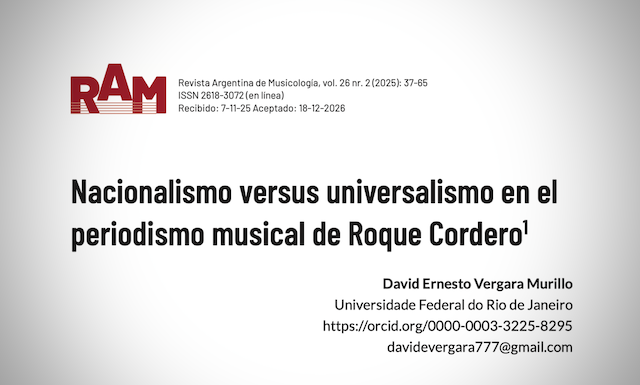
Nationalism versus Universalism in Roque Cordero's Musical Journalism
Keywords:
Roque Cordero, musical journalism, nationalism, universalism, twelve-tone musicAbstract
This article analyzes the journalistic work and aesthetic thought of Panamanian composer Roque Cordero (1917–2008). Through a historiographical review of his texts published between 1952 and 1978, it examines the relationship between nationalism and universalism in his musical discourse. Cordero used journalism as a critical platform to ponder on the role of art, education, and professionalism in Panamanian musical endeavor, proposing that Panamanian music should be capable of uniting national identity and universal projection. In articles such as “El folklore en la creación musical panameña” (1952) and “Contra el cutarrismo en nuestra música” (1978), he reveals his rejection on nationalism based on folkloric citations and his defense of an art based on technical authenticity and the creative transformation of folklore. In texts such as “Nacionalismo versus Dodecafonismo” (1959) y “El público y la música viva” (1975), Cordero argues that modern technique –including dodecaphonism– is not contrary to the national spirit, but rather a means of expressing Latin American sensibility with rigor and contemporaneity. His musical journalism presents one of the great Latin American modernist dilemmas of the epoch: the search for a synthesis between national authenticity, technical discipline, and aesthetic universality.
Editorial History
Received: November 7, 2025
Accepted: December 18, 2025
Downloads
References
Astor, Miguel. “Los ojoS de Sojo: El conflicto entre Nacionalismo y Modernidad en los Festivales de Música de Caracas (1954–1966)”. Tesis de doctorado, Universidad Central de Venezuela, 2008.
Bellaviti, Sean. “Panamanian Musical Nationalism: A Critical Historiography”. Latin American Music Review 39, nro. 1 (2018): 81–121.
———. Negotiating Musical Style in Panama: Nationalism, Professionalism and the Invention of Música Típica Popular. Tesis de doctorado, University of Toronto, 2013.
Carles Rosas, María Elena y Juan Abelardo Carles Rosas, colab. "Roque Cordero", en Protagonistas del Siglo XX Panameño. Nomos
impresores, 2015.
Casal, Luis. Panamanian Art Music for Strings: Works for Violin/Piano and Viola/Piano by Roque Cordero, Eduardo Charpentier, and Fermín Castañedas. Tesis de doctorado, Facultad de Música, University of Oklahoma, 2006.
Chase, Gilbert. “Composed by Cordero.” Inter-American Music Bulletin, September 1958, 1-4. Washington, DC: U.S. Pan-American Union.
Cordero, Roque. “Remembranzas.” Página 24, septiembre–octubre de 1987.
———. “Contra el Cutarrismo en nuestra música, se pronuncia el Maestro Roque Cordero.” La República, 2 de julio de 1978.
———. “Vigencia del Músico Culto”. América Latina en su música, editado por Isabel Aretz, 164-xx. Ciudad de México: Siglo XXI Editores, S.A., 1977.
———. “El Público y la Música Viva.” El Panamá-América, 13 de abril de 1975.
———. “La Música en Centroamérica y Panamá.” Journal of Inter-American Studies 8, nro. 3 (1966): 411–418.
———. “La Música en Panamá.” Revista Lotería, nro. 75 (1962): 56–61.
_______. “¿Nacionalismo versus Dodecafonismo?” Revista Musical Chilena 13, nro. 67 (1959): 28–38.
———. “El Folklore en la creación musical panameña.” Revista Universidad, nro. 31 (1952).
Dahlhaus, Carl. Nineteenth-Century Music. Berkeley: University of California Press, 1989.
Filós, Priscilla. “The Piano in the Works of Roque Cordero”. Tesis de doctorado, Facultad de Música, Indiana University, 1974.
Garay, Narciso. Tradiciones y Cantares de Panamá. Bruselas: Presses de L’expansion belge, 1930.
Guevara, Moisés. “Panamanian Folk Influences in Roque Cordero”. Tesis de maestría, Facultad de Música, University of Oklahoma, 2001.
Kolb Neuhaus, Roberto. “Janitzio, ¿música de tarjeta postal? La retórica del anti-paisaje revueltiano.” Colección Bitácora de Retórica XXIII. México: Instituto de Investigaciones Filológicas, UNAM, s. f., último acceso: 22 de enero de 2026, http://www.fororevueltas.unam.mx/index.php?nivel=2&&doc=8
Labonville, Marie. “Roque Cordero (1917–2008) in the United States.” Ponencia en Latin American Music Center’s Fiftieth Anniversary Conference, Cultural Counterpoints: Examining the Musical Interactions between the U.S. and Latin America. Bloomington: Indiana University Scholar Works, 2011. https://scholarworks.iu.edu/iuswrrest/api/core/bitstreams/819e7997-a9c7-41e5-bc0c-acb082c8b329/content
Lowe, Jorge. “La Labor Educativa y Creativa del Dr. Roque Cordero”. Tesis de licenciatura, Facultad de Filosofía, Letras y Educación, Universidad de Panamá, 1970.
Young, Phillip. NGAWBE: Tradition and Change among the Western Guaymí of Panama. Urbana: The Board of Trustees of the University of Illinois, 1971.
Vergara, David. “La Segunda Sinfonía de Roque Cordero: aspectos de índole histórico relacionados con su génesis y un enfoque analítico de sus últimos 75 compases”. Tesis de licenciatura, Facultad de Bellas Artes, Universidad de Panamá, 2021.
———. “Roque Cordero: A Recepção da Segunda Sinfonia e a Influência do Modernismo Musical Norte-Americano no Festival de Caracas de 1957”. Tesis de maestría, Universidade Federal do Paraná, 2024.
Volpe, Maria Alice. “Indianismo and Landscape in the Brazilian Age of Progress: Art Music from Carlos Gomes to Villa-Lobos, 1870s–1930s”. Tesis de doctorado, The University of Texas at Austin, 2001.
———. “A música na imprensa periódica: Metodologia e Interdisciplinaridade.” En Periódicos & Literatura: aproximações, organizado por Fernando Monteiro de Barros Júnior y Raquel França dos Santos Ferreira, 121-185. Rio de Janeiro: Fundação Biblioteca Nacional, 2022. (Cadernos da Biblioteca Nacional; 19.)
Wade, Peter. Music, Race, and Nation. Música Tropical in Colombia. Chicago: The University of Chicago Press, 2000.
Additional Files
Published
Issue
Section
License
Copyright (c) 2026 David Ernesto Vergara Murillo

This work is licensed under a Creative Commons Attribution-NonCommercial 4.0 International License.
Attribution-NonCommercial 4.0 International
https://creativecommons.org/licenses/by-nc/4.0/
You are free to:
- Share — copy and redistribute the material in any medium or format.
- Adapt — remix, transform, and build upon the material.
- The licensor cannot revoke these freedoms as long as you follow the license terms.
Under the following terms:
- Attribution — You must give appropriate credit , provide a link to the license, and indicate if changes were made . You may do so in any reasonable manner, but not in any way that suggests the licensor endorses you or your use.
- Non Commercial — You may not use the material for commercial purposes .
- No additional restrictions — You may not apply legal terms or technological measures that legally restrict others from doing anything the license permits.
Notices:
You do not have to comply with the license for elements of the material in the public domain or where your use is permitted by an applicable exception or limitation .
No warranties are given. The license may not give you all of the permissions necessary for your intended use. For example, other rights such as publicity, privacy, or moral rightsmay limit how you use the material.


 The works included in this magazine are published under the